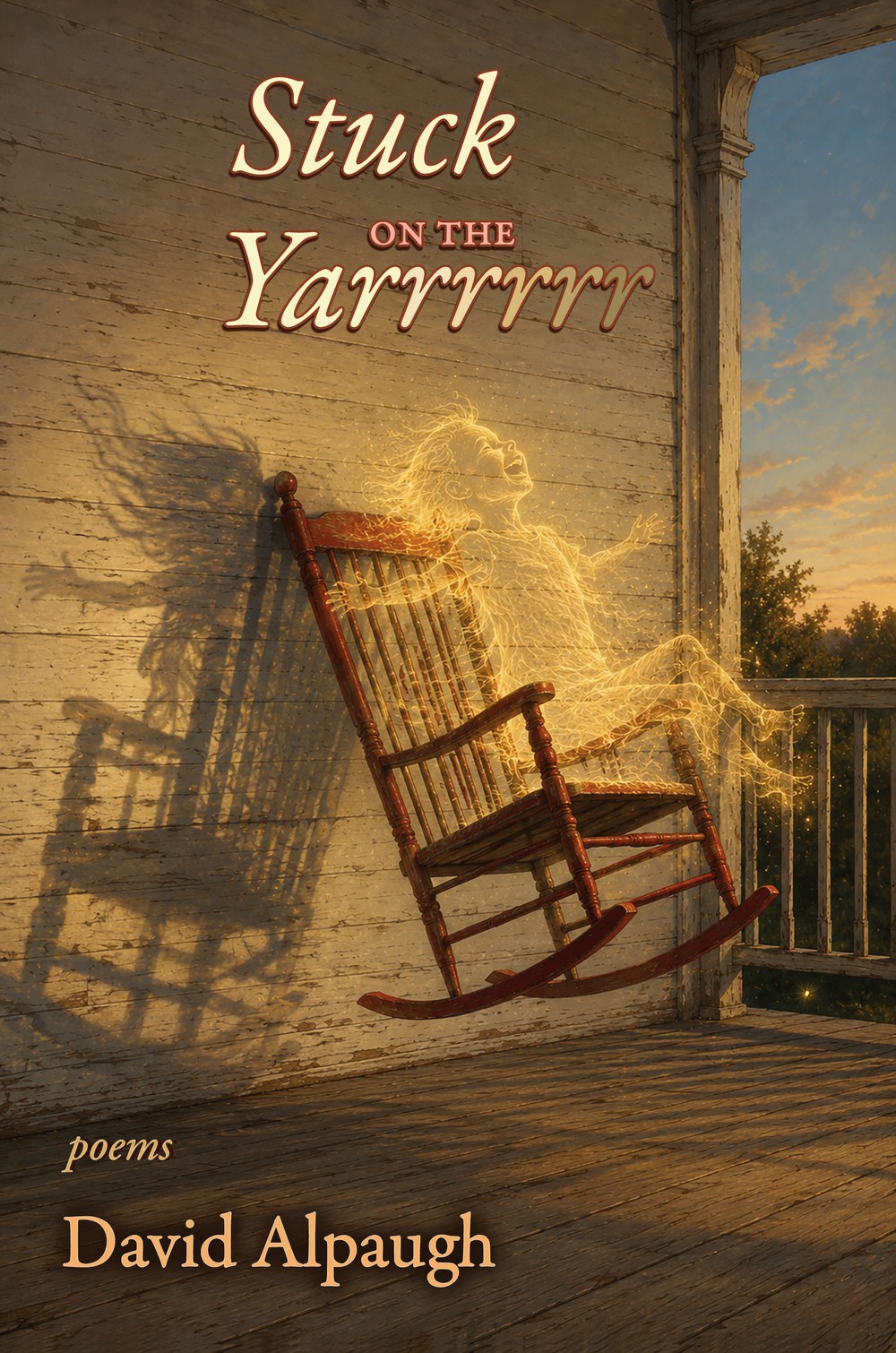
Alpaugh’s take on the world is at once profound, ironic, and deeply humorous. His poems take us on journeys where every path leads to a surprising destination. Childhood reminiscences about bikes and cowboys somehow arrive at modern scams and active shooters. Another poem exposes the absurdity of religious ritual through the disarmingly innocent perspective of a child. Weighty subjects like immortality are examined with wit in poems such as “Reading Frenzy” and “Walking the Plank.” Accompanying images are brilliantly chosen, deepening and echoing poetic meaning. And when Alpaugh employs classic forms, they remain entirely in service to the poem, never calling attention to themselves; a literary tightrope walk few poets can manage.
— Edward Pandolfino, author of Birds of the Sierra Nevada
David Alpaugh is not a “professional poet.” If you told him you wanted to be a poet, he’d probably advise you to get a job, a real job—plumber, forklift driver, assassin. In fact, this new book has all the guile and nonchalance of an experienced assassin, with none of the gravitas and liturgical languor one finds in the usual poetry reading—John Wick, not Tom Clancy. Consider this send-up of Wallace Stevens from “Thirteen Ways of Looking at a Rocket Scientist”: “I was of three minds, / Like a rocket / In which there are three stages.” Few literary saints escape his skewering: Dickinson, Williams, and Frost (along with dozens of others) come in for his cadaverous attentions. Invoking Gertrude Stein, he laments “there’s no here here.” Aging, death, and our calamitous political moment, he takes it all in, but with humor and sarcasm. Augmented by a host of whimsical AI-generated illustrations, his poems offer us escape and that sturdiest of pleasures, respect for our own intelligence.
— Lee Rossi, author of Say Anything
It’s hard to write funny, harder still to write funny while saying something profound. But with his shrewd wit and iconoclastic mind, David Alpaugh has mastered the art. From farts to cadaver dogs, rocket scientists to Iron Chefs to Barbie’s playhouse, nothing escapes his scrutiny. He eyes life’s absurdities even as he invites compassion for our human failings. Alpaugh’s allusions to other works and writers deepen and enrich the poems while illustrations by ChatGPT’s “artist in residence,” AI, offer illuminating pauses for reflection. Everything herein belies the book’s title: There’s nothing stuck anywhere in this bracingly original work.
— Lynne Knight, author of The Language of Forgetting